Harvard Researchers Innovate Knitting with Shape-Shifting Smart Fabrics
Researchers at Harvard University have transformed traditional knitting into a groundbreaking method for creating smart fabrics that can change shape and perform various functions. This innovative approach utilizes elastic yarns and advanced knitting techniques to develop textiles capable of sensing movement and acting as switches, paving the way for a new era of programmable textiles.
Knitting is evolving beyond the creation of simple garments like sweaters and hats, as researchers at the Harvard John A. Paulson School of Engineering and Applied Sciences (SEAS) have demonstrated the potential of conventional knitting techniques to produce functional fabrics. These innovative textiles can change shape, sense movement, and operate as switches, heralding a new generation of programmable textiles.
The research, led by Kausalya Mahadevan, a recent Ph.D. graduate now working as a postdoctoral associate in Katia Bertoldi's lab, showcases how specialized machine-knitted fabrics can 'snap' from one stable shape to another. This phenomenon, known as multistability, allows the fabrics to maintain multiple stable configurations, much like a light switch that remains in either the 'on' or 'off' position.
Mahadevan expressed her excitement about the intersection of fabrics and engineering, noting that the inspiration for their work came from the artistic approaches of textile artists combined with the lab's focus on nonlinear mechanics in solids. Unlike traditional methods that often involve molding polymers, this research utilizes weft knitting techniques, commonly used for producing hats and gloves, to create complex curved structures using yarn alone.
The team selected highly elastic yarns and employed a knitting method called plating, which involves placing different yarns on opposite sides of the textile. This combination resulted in dense, thick fabrics that naturally curl into three-dimensional shapes, leveraging the same behavior that causes the edges of cut T-shirts to curl.
By arranging horizontal and vertical stripes in systematic combinations, the researchers developed textiles capable of snapping between different configurations while remaining stable in each one. They also explored how the geometry and material properties of the fabric influenced this snap-through behavior, treating each textile as a continuous material rather than modeling every individual strand of yarn.
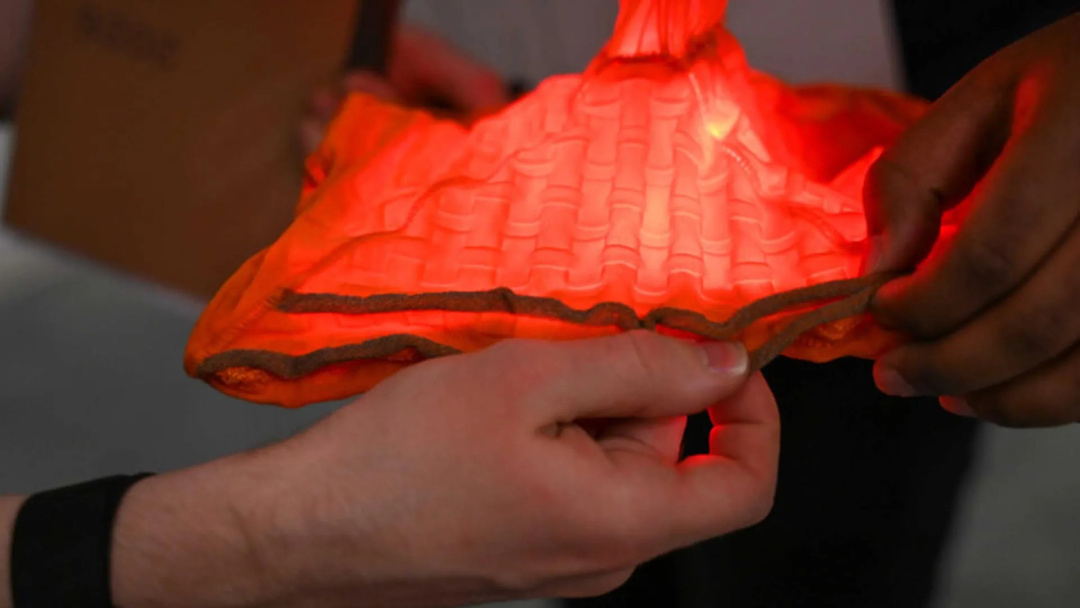
In an exciting application of their findings, the researchers integrated thin conductive yarns into the knitted structures, transforming them into soft, stretchable electric switches. For instance, one prototype featured a multistable knitted shell that could turn an LED light on and off as the fabric shifted between its stable states. Another wearable textile switch could be placed over a knee or elbow, detecting movement to count steps using an Arduino.
The potential for these innovations extends beyond simple switches. The researchers created a reconfigurable lamp shade with multistable switches that controlled different colors of light based on the fabric's configuration. These prototypes were showcased in a recent Art Lab installation, highlighting the artistic and functional possibilities of this technology.
Importantly, the knitting machines used in this research are similar to those found in garment factories, indicating that this technology could be scaled up for mass production. From a scientific standpoint, this work bridges the gap between textiles and nonlinear mechanical metamaterials, engineered structures designed to bend and snap in controlled ways for practical applications.
Looking ahead, Mahadevan envisions a future where multistability in textiles could lead to fabrics that seamlessly integrate softness, functionality, and the ability to adapt their shape. This research not only pushes the boundaries of what knitting can achieve but also opens doors to a new realm of smart textiles that could revolutionize the industry.